




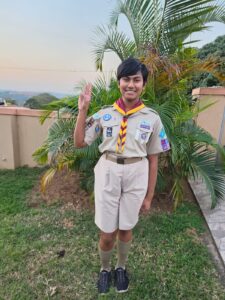
 17-year-old Scout Aarushi Bhoora from the 1st Umbogintwini Scout Group recently spearheaded a clean-up project at Amanzimtoti Japanese Gardens, removing the invasive Kariba weed. The service project, as part of her journey towards her Springbok Award, taught Aarushi that by leading environmental projects, young people can change the world.
“I joined the 1st Umbogintwini Scout Group when I was ten years old because one of my friends wore her Scout uniform to school. I was amazed by the activities Scouts got to do, and when I turned eleven, I moved up into the Scout Troop. At first, I stayed because my school friends were involved, but when the pandemic struck in 2020, a lot of them left. I slowly started feeling lonely until my amazing Troop Scouters, Mr and Mrs Eagle, noticed and then encouraged me to become more involved in 2021. A turning point in my Scout career was when I had to attend a Springbok Scout hike as a younger Scout. This remains to be one of the best memories I have. It was the first time I had ever done a hike that was longer than a day and I loved every second of it. Another memory was leading the construction of a raft and staying the night on it with 3 other Scouts. Adventures and activities like these are what kept me coming back,” she explains excitedly.
“Scouts has also given me something much bigger than adventure—it has given me a place where I belong. Scouting has made me bond with others and experience things with people who I never would have spoken to. Here, no matter where you come from, the culture welcomes you in. I have made friendships for a lifetime and experienced things you will never experience at school with those friends. Those experiences bring you a lot closer together.
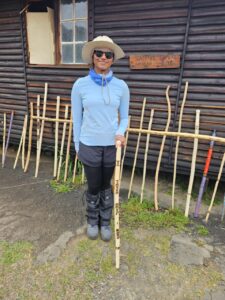
Aarushi’s hike
Scouts has taught me so many important lessons, but there is one lesson I have learned that stays with me. That lesson is that fear is temporary. Before the Springbok hike that I attended as a younger Scout, I was terrified. My parents weren’t going to be with me, there were no adults, what if there are dangerous animals … and so many other fears were playing in my head the night before the hike. I just wanted to quit or say that I was very sick. I eventually gathered up the courage to stick to my choice and went on the hike. When I was alone with my Scout friends, all my fear had faded. We sang; we laughed and we chatted. I made so many memories on that hike and that made me realise what I would have missed out on if I had let fear win.” After many hiking adventures since then, what is the one thing she always packs in her backpack? “Cotton wool! It comes from a very funny story in Scouts. We had run out of firelighters and tinder pieces of wood. I – for some reason – had had a whole big bag of cotton wool and it had worked better than the firelighters. The cotton wool allowed us to start our fires to cook our meals. My nickname for a while became ‘Cotton wool’,” she laughs.
Over the years there are many skills she has learned that help her fulfil her desire to help. “I am proud of my First Aid skills,” continues Aarushi. “These skills have enabled me to help others when needed. Even when I’m not in Scouts. I have helped a few people at school with my First Aid abilities.”
Today, Aarushi is completing her own Springbok Scout Award. “Completing my Springbok Adventure Theme badge was an experience I will always remember. I was very stressed about my hike as I chose the Drakensberg. We started at Monk’s Cowl and ended near Bergview Cottage. This hike was 34,2km over three days. It was a very tough and strenuous hike, as the total elevation gain was 1217m. The weather was also not on my side. The amount of responsibility I had was very overwhelming, as I had the lives of 4 other Scouts in my hands. On day 1, one thing after the other kept going wrong. I remember being so stressed, I had cried in my tent, just wanting to go back home. I started doubting my skills. But I still had to continue, and I finished the hike 34,2km later. Getting that badge became a reminder to myself of what I overcame and that I should never doubt my skills and abilities.
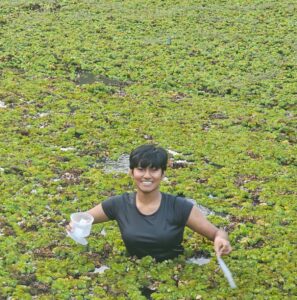
Aarushi removing Kariba weed
The second project I organised was a community clean-up at the Amanzimtoti Japanese Gardens with WESSA, Tidy Towns, fellow Scouts and community members to remove invasive Kariba Weed from the pond. As a Life Sciences student, environmental conservation has always interested me, so when the opportunity came to lead this project, I knew I wanted to make a difference” she continues. Leading such a large service initiative was challenging. “It was stressful to lead a project like this. Contacting people and making sure the message reached everyone was hard. It taught me how to balance academics as a Matric learner with my Scouting responsibilities and reminded me about the importance of time management. I also learned lots of communication skills including how to sound professional when contacting and phoning people. At the end of the clean-up, it was difficult not to feel discouraged. The Kariba weed grows incredibly quickly, and despite all our hard work, we couldn’t clear the entire pond in a single day. Then something happened that reminded me why service matters. When we went back to release the weevils that the Toti conservancy provided us, we saw birdlife around the pond. Seeing the birds there reminded me that we had made a positive difference! The project also taught me something I didn’t expect. You don’t need a huge project that costs a lot of money to make a change for the environment. You – as an individual – can make a change. It really does start with you. Once I started the project, it got a lot of publicity educating people on the importance of removing alien plants. I realised that service is about much more than the task itself. It is about inspiring others to become part of the solution. That is why I believe young people have an important role to play. If we as youth don’t make a change for our future, then who will? It is our future in our hands. If we don’t do anything about the environment we live in, it is progressively going to get worse to a point where it will not be able to be saved, where biodiversity does not exist, where we cannot show our future children a species of plant or flower, because they went extinct. This is why more youth should start to act, the sooner we fix these issues, the better off we will be in the future.”
The other two projects she completed were her Springbok camp and her pioneering project. “My camp was a 3-day long camp that focused on developing the skills of my Scouts for their advancements. We mainly focused on pioneering. This was one of my favourite projects, as almost all my Scouts had attended. For the pioneering challenge I built an hourglass tower that stood almost 6m high. It could safely hold 3 Scouts at the same time, and it took us around 4 hours to make.”
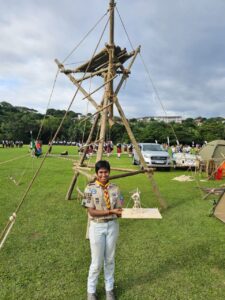
Aarushi’s pioneering project
Aarushi was 16 when she started the journey to Springbok. So, was she prepared? “Scouting gave me the tools to plan. The Scout advancement system is designed very well, as the higher you go up you get slightly more responsibility and less help in terms of planning from your leaders. And as you go up, it gives you the opportunity to watch how your Patrol Leaders plan activities and host them, till it is your turn to plan that activity. Watching my Patrol leaders plan activities showed me how to do it as well, giving me the tools to plan and run events in Scouting”, she explains.
Aarushi speaks with confidence and purpose. “Scouting has changed me a lot. I cannot imagine a version of myself without Scouts. It has become such a big part of my life and has helped me come out of my shell and become a better leader. Today, I serve as the Deputy Head Prefect at my school, and I use the leadership skills I learned through Scouting every day. It’s also important to know your limits and know when you are taking on too much.
Looking back, I believe that Scouting is very important for young people, especially in an age where social media and technology exist. People do not spend time outdoors and they prefer to stay inside scrolling on their phones or playing video games. I will admit, I am guilty of this too, but Scouts allows me to explore the outdoors and to ground myself with nature, while learning skills that most people choose to not learn, such as mapwork, because they have GPS on their phone. When people ask me to describe my Scouting journey, three words come to mind: fulfilling, adventurous and challenging. Fulfilling, because I was able to serve others. Adventurous, because I have explored places I would never have visited on my own. Challenging, because every obstacle has helped me discover what I am capable of.
As I prepare for university next year, I hope to continue serving in Scouting wherever I am. If I stay in KwaZulu-Natal, I would love to become an adult helper. If I study elsewhere, I hope to join a local Scout Group once I have settled in. I hope to become the kind of role model that inspired me. Because, I have learned that real leadership begins with service, and real change begins when one person decides to act.”