




By Blade Hanger, 2nd ASM
Don’t just tell young people that they are the future, give them the tools to shape it. There is no shortage of conversations about Africa’s youth being “the leaders of tomorrow”. But what if we stopped waiting for tomorrow? What if, instead of simply telling young people that they are the future, we gave them the skills, confidence and opportunities to shape their communities today? This was one of the most powerful lessons from the 2nd Africa Scout Moot, hosted by SCOUTS South Africa in Arrowe Park in Benoni.
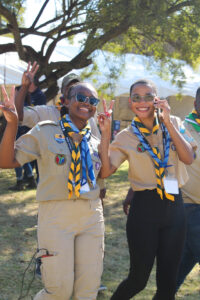
Over 300 young people from more than 40 countries came together under the theme “Phezulu Nangaphezulu” – Higher and Higher. They came for adventure and friendship, but they left with something far more valuable: opportunities to practise the skills needed to navigate an increasingly complex world. The event emphasised inclusion and equality, while embracing diversity. As such, enabling the young leaders present to learn about different cultures and backgrounds, to discover shared interests, and to appreciate differences.
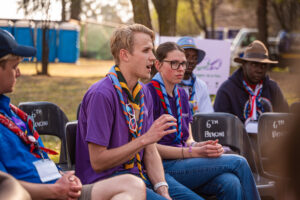
Across the Moot’s Africa Development Village, young people moved between bases that challenged very different aspects of leadership and citizenship. At the “Peace and Community” base, they explored conflict styles, dialogue and conflict resolution. The lesson was not simply how to avoid conflict, but how to engage constructively when people disagree. Through the “Life Leaders” activities, Rovers were challenged to use design thinking and innovation to develop ideas, solve problems and pitch solutions. They were not being told what the answer was. They were being given the space to find one. Evaluating their personal impact on our environment became personal by calculating individual carbon footprints and measuring single-use plastic consumption. Health and well-being activities similarly encouraged young people to question everyday choices and understand their impact.
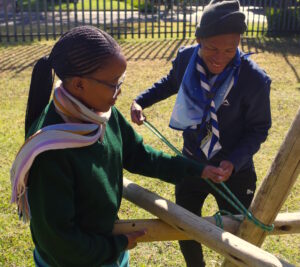
The Ubuntu service projects placed the young men and women present in situations where they were encouraged to think about the consequences of human actions and how small initiatives can have big impacts. What seemed like a bottle full of plastic scraps was actually a building block for local education and environmental sustainability.
World Scouting, Jonathan Law
These may look like very different activities. Together, however, they tell a much bigger story. Youth empowerment is not one skill. It is a collection of capabilities for both women and men alike. It is knowing how to communicate when people disagree. It is having the confidence to stand up and pitch an idea. It is understanding how your choices affect the environment. It is knowing how to respond when a crisis occurs. It is being able to work with someone whose background or culture is completely different from your own. It is recognising that your health, your digital behaviour and your actions in your community all form part of the citizen you are becoming.
Most importantly, it is recognising that these skills were not taught through lectures alone. They were learned by doing, by interacting with young women and men who share a desire to create a better world. That distinction lies at the heart of Scouting’s educational approach. Young people are given opportunities to try, make decisions, collaborate, make mistakes, adapt and try again.
This is particularly relevant as we celebrate South Africa’s Women’s Month theme, “Empowered women empower the nation.” Empowerment cannot simply mean encouraging young women to believe that they can lead. In Scouting, this means creating spaces where girls and young women, as well as boys and young men, can actually develop the capabilities that make leadership possible.
World Scouting, Jonathan Law
When a young woman stands in front of a group and pitches an idea, navigates a disagreement, leads a team through a challenge or takes responsibility for a community project, she is not preparing for some distant future. She is practising leadership now.
And when young men experience capable female leaders as their peers from an early age, they learn that collaboration, respect and shared responsibility are simply part of how communities work. This is the kind of cultural change that cannot be created through slogans alone. It is built through experience. And this is where the Scout programme and Scouting methodology shine.
Africa’s young people face enormous challenges, from unemployment and inequality to environmental pressures, conflict, digital risks and rapidly changing economies. We cannot prepare them for these challenges by giving them information alone. We need to give them agency, trust them with real responsibility and accountability over their decision making and actions. That is what the 2nd Africa Scout Moot demonstrated.
Its greatest legacy may not be the activities completed during one extraordinary week in South Africa. It may be the confidence Rovers take home: the confidence to speak, to listen, to question, to collaborate, to serve and ultimately to act.
If we genuinely want an empowered generation that embraces equality and inclusion, we cannot keep them waiting on the sidelines. That is why within SCOUTS South Africa we make sure we give young people the tools, responsibility, voice, and above all the opportunity to put their learning into action. That is how we enable them to grow together and move Phezulu Nangaphezulu—Higher and Higher.